Saved: 2026-04-14-172554
Title: Applied Intuition’s Qasar Younis on Radical Pragmatism and Building a Company to Last
Published Time: 2026-04-14T14:19:39+00:00
Markdown Content:

There are still a few slots open at our invite-only café in San Francisco!
RSVP on Partiful using the links below to reserve your spot on one of the five days:
Monday (4/20) | Tuesday | Wednesday | Thursday | Friday (4/24)

🏛️ Today is Demo Day for the class of SR006! We’ll be sharing lots of photos on our social accounts. Signups are closed for this one, but if you’d like to join us at the next Demo Day, register here.
💰 Shout out to Rork (SR005) on their $15M seed round!
🏋 Andrew Chen explained what the bar is to get into speedrun on a recent episode of George Bandarian’s Agentic Podcast
💼 Join our talent network for more opportunities. If we see a fit for you, we’ll intro you to relevant founders in the portfolio
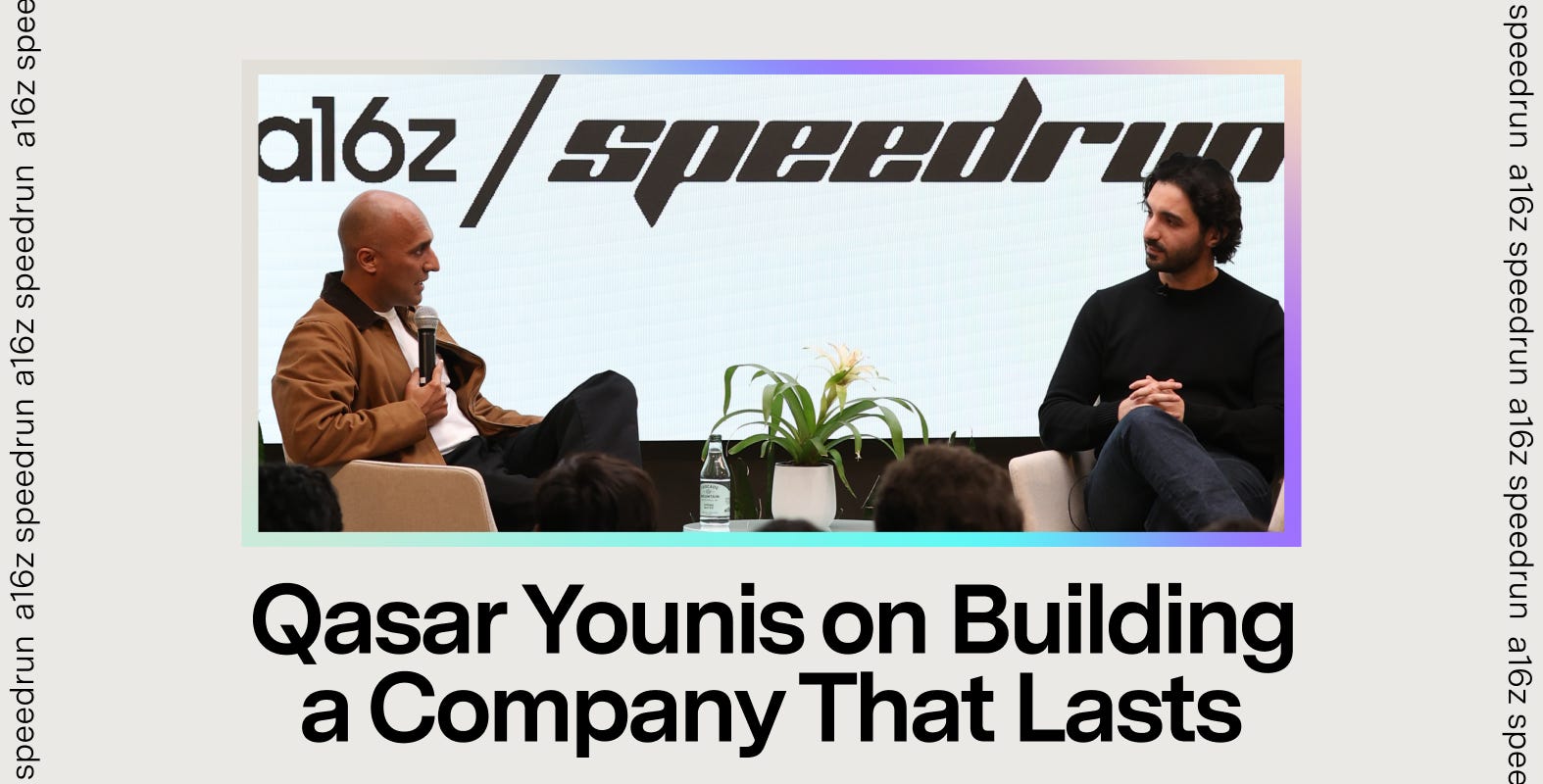
Qasar Younis is the co-founder and CEO of Applied Intuition, a $15 billion AI software company for autonomous systems. Previously, Younis was an automotive engineer at General Motors, built two startups (the second acquired by Google, where he ended up reporting near the top of the org), and served as COO at Y Combinator.
In a fireside chat with a16z speedrun investing partner Kenan Saleh, Younis laid out how he thinks about decision-making, culture, recruiting, work ethic, and what it actually takes to sustain a company for the long haul. His philosophy, which he calls “radical pragmatism,” boils down to stripping emotion from decisions and refusing to borrow frameworks wholesale from anyone else, including him.
Watch the full conversation below, or scroll down for our top five takeaways from the conversation:
Younis’s central philosophy is what he calls “radical pragmatism”—a term so core to his identity that radicalpragmatism.com literally redirects to his website. The idea came from years of watching smart people give confident advice that didn’t transfer. At YC, he was surrounded by successful CEOs who all had strong, often contradictory views on how companies should run, and it started to make him feel a little crazy. Applied Intuition, his third company, became the place where he could finally test his own instincts. The results gave him his sanity back.
“When you think about your company, you can’t take ideas from me or other people. You have to make decisions based on the reality of who you are as a person, who your co-founder is, the stage and the resources you have available, the state of your competitors and the state of the market.”
He drew an analogy to Bruce Lee, who studied every martial art and then created his own—one built for practical use, not tradition. Younis sees startup advice the same way: most of what gets said in interviews is seventy percent entertainment and thirty percent practical usability. “It’s like watching Breaking Bad for life advice,” he said. “High school teachers who get cancer just die. That’s the sad reality.”
This is to say: Take all the advice that follows with a grain of salt.
When Applied Intuition was about a dozen people and had landed $10 million in business, Younis and his team went to a house in Santa Cruz on a Friday afternoon and wrote down why they thought they had early success. That became the company’s ten values—less a statement of aspiration than a forensic analysis of what was actually working. The hypothesis: as you grow to thirty, fifty, two hundred people, you regress to the mean. The values were meant to fight that.
“A lot of companies have values. So why do some companies maintain this very prickly shape where they’re so distinct? One of the key reasons is we compensate and we promote against adherence to our values. That’s what makes them actually real.”
The mechanism is specific: each of the ten values has roughly five observable behaviors underneath it—about fifty in total. Every individual contributor rates their manager on a one-to-five scale for each behavior, and you can’t pick three. Questions like “My manager is decisive,” “My manager is a good teacher,” “My manager is the most technically competent person on the team,” and even “My manager works harder than me.” When you ask a thousand engineers that last one, Younis pointed out, you find out very quickly which managers actually work hard—because answering “yes” means admitting you’re the lazier one.
Younis has a simple heuristic that has shaped much of Applied Intuition’s culture: whatever large companies do, don’t do that. Big companies love org charts? Don’t have one until fifty people. Big companies love titles? No titles. Big companies love LinkedIn? No employee was on LinkedIn until five years into the company.
“We would have competitors—rest in peace—and I’d tell the recruiting team: go create the org chart for them. They would literally go to every one of their employees’ LinkedIn profiles, see their job titles, see what they’re doing, and reverse-engineer their org chart. And then it was like, if we can do that to them, they can probably do it to us. Everyone’s off LinkedIn.”
The no-titles policy also serves as a hiring filter: when someone interviewing is really title-oriented, that tells you something. Younis also kept his calendar public to the entire company for ninety-five percent of its history, as did his co-founder and leads. The logic: if your calendar isn’t full of product reviews and customer meetings, you should be embarrassed. “Shame is a great moral compass,” he said.
One of the biggest things Younis said he’d changed his mind about is fundraising. He used to believe that if the company was genuinely great, everyone would just know. He now considers that a fantasy.
“I had this fantasy that if the company is really good, everyone’s going to know. They won’t. Raising money does send messages. It’s sending a very clear message to your employees, other investors, your competitors, and your customers that you’re doing well.”
Applied Intuition has raised a billion dollars and has never used any of it. The fundraising itself is the product: it’s a signal to the ecosystem, done at minimal dilution (about one percent in the last round). Younis was candid that this was a belief he had to be dragged into. He credited Marc Andreessen with pushing him to get the word out, telling him that nobody knew about this great company because of his “hermit-like view from Sunnyvale.”
Similarly, he begrudgingly admits that hyping your company matters.
“I hate to say it because I feel like I’m in middle school trying to get you to smoke or something. You’ve got to hype the company. But if I was sitting alone thinking, what do I believe today that I didn’t believe ten years ago? That’s one of them. I just felt like the good companies will get known. No.”
Younis has worked seven days a week since he was fourteen. And the companies Younis admires most—Berkshire Hathaway, Nvidia—are led by people who have been at it for decades. Jensen Huang has been CEO for thirty years. “A lot of people can do this for two or four years,” Younis said. “But to figure out how to do it while entire markets change and countries change and culture changes—that’s operating at the highest level.”
“One of our core values is “laugh a lot.” If you’re not having a good time and you’re not enjoying yourself, you’re not going to make it. You’re just not going to make it. The ego is such a powerful thing—you’ll rationalize all the reasons you want to give up.”
“This is a tough job,” Younis says. “You get phenomenal return for it. I still think, risk-adjusted, reward-adjusted, I would do this over Taco Bell every day of the week. That’s why I did it.”
That’s it for this week! Thanks to Qasar Younis for speaking with our founders.
For more weekly dives into the world of early stage startups, subscribe below.