Source: https://speedrun.substack.com/p/ai-tools-for-gtm-and-sales
Saved: 2026-03-21-133858
Title: How a16z speedrun Founders Are Using AI Tools for GTM
URL Source: https://speedrun.substack.com/p/ai-tools-for-gtm-and-sales
Published Time: 2026-03-03T17:26:59+00:00
Markdown Content:
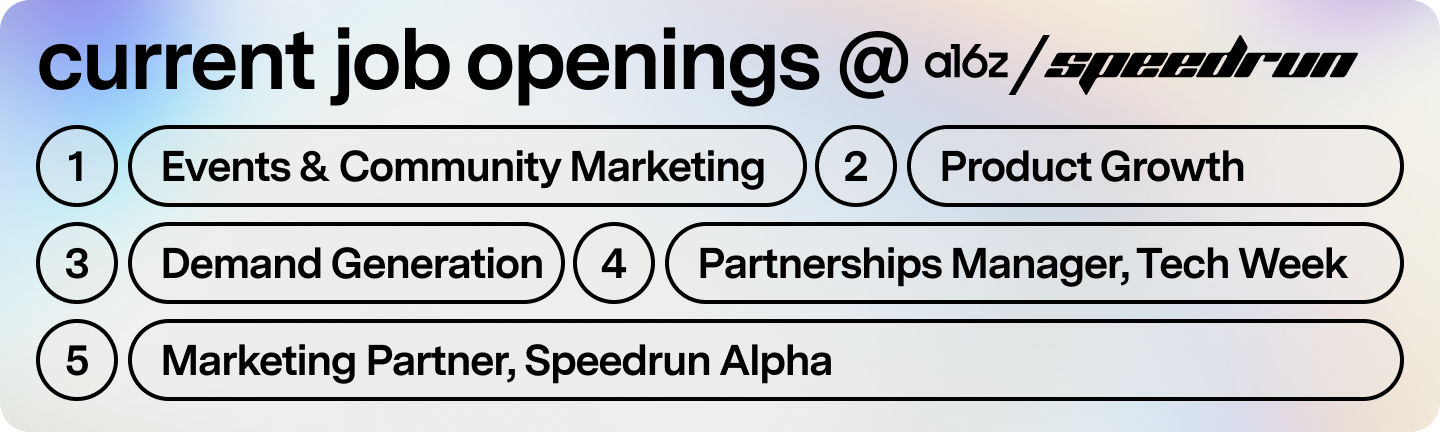
The a16z speedrun team is hiring! We’d love to get your application for:
-
Events & Community Marketing - Run the founder experience for teams accepted into speedrun
-
Product Growth - Help our founders gain traction through modern product-led growth strategies
-
Demand Generation - Help build our investor community
-
Partnerships Manager, Tech Week- Help grow and support our Tech Week partner network
-
Marketing Partner, Alpha - Help us build and grow our exciting new fellowship program for early-career technical talent
You can also see all our openings here. We can’t wait to receive your application.
Now, onto this week’s main story.

The old founder-led sales playbook went something like this:
You manually send DMs on LinkedIn for two hours, hand-write cold emails to everyone you could think of, track everything in a spreadsheet, pray. If you were selling to enterprises, all you had to do was multiply your expected pain by twelve and add a procurement department.
That playbook is (thankfully) kaput. AI-native founders are now selling to banks, hospitals, law firms, and universities with zero dedicated sales hires. The type of sales processes that used to take 18 months can now go much, much faster.
The unlock comes from two capabilities converging:
-
computer use agents are finally good enough that they can work autonomously
-
automated outbound pipelines are cheap and easily accessible.
In 12 months our inboxes are likely to be spam-filled and stuffed with AI slop. For now though, most of the world hasn’t figured out how to do this, so there is a brief, glorious moment where founder-led sales can use AI to accelerate revenue growth.
Here’s how speedrun founders are building the stack.
Computer use is the capability that changes everything about solo founder sales. These are AI agents that can see your screen, click buttons, fill out forms, and navigate web apps. By freeing yourself from the constraints of APIs and MCP, you can build a janky but serviceable SDR with a minimal amount of effort.
Tools like Claude Cowork, OpenAI Operator, and similar browser-control agents can do most of the things you can do in Chrome. And most prospecting workflows live in browser-based tools like LinkedIn Sales Navigator and CRMs that either don’t have APIs or charge enterprise prices for access. Computer use bypasses all of that.
Shawn Tsao, cofounder and CEO of Snapp(SR006), runs Cowork on a browser tab pointed at Sales Navigator. It reads his ICP filters, clicks through profiles, and sends connection requests on autopilot, maxing out LinkedIn’s 200-per-week limit. Each lead gets added to a Sales Nav list spreadsheet, which then flows into Dripify for automated LinkedIn drip sequences. His own review: “A bit scuffed, but it saves a ton of time.”
How to replicate this today:
Define your ICP in Sales Navigator using title, company size, industry, and geography filters. Open Cowork (or your browser agent of choice) on that Sales Nav tab. Instruct it in plain English to connect with matching profiles and add them to a named lead list. Then pipe that list into a LinkedIn automation tool like Dripify or Expandi for follow-up sequences. Treat the browser agent as a junior SDR who can do anything you can do in a browser. You just tell it what to do.
To be clear: this will almost certainly break or have weird edge cases. But that’s ok! If you’re an early stage founder, perfect processes are reserved for those with product-market fit.
Tsao adds one more tip:
“I also ended up building my own AI Agent that doesn’t require Sales Navigator but uses publicly found information to get cold leads and even writes out the exact email and places it into my Gmail drafts.”
The second layer moves beyond simple prospecting into full pipeline automation. AI manages sourcing, enrichment, outreach, and response routing end to end. An orchestration stack typically combines tools like Clay, Lemlist, and Attio as the central hub, connecting data sources, AI enrichment, and outbound channels into a single workflow.
Silvia Chen, cofounder and CEO of Bilrost(SR006), built this exact type of system to sell loan processing automation software to commercial and business-purpose real estate lenders. Leads are sourced, enriched and qualified in Clay, synced into Lemlist for personalized outreach, and routed through an AI-driven decision tree. Each response triggers a different path: message viewed, reply received, no response, objection raised. Each generates its own tailored follow-up sequence, and the system runs autonomously until a prospect is ready for a live conversation.
Chen told us that now her “LinkedIn DMs are so flooded I can’t open the app.” When she launched a last-minute, conference-specific campaign ahead of a major industry event, her calendar filled up from landing to takeoff with high-quality, in-person meetings—selling into banks, one of the most conservative and difficult buyer segments.
How to replicate this today:
Start by building your lead list in a tool like Clay or 11x, which can pull from LinkedIn, Crunchbase, and company databases based on your ICP filters. Use Clay’s AI enrichment to research each lead, write personalized first lines, and identify the right entry point at each organization. Route enriched leads into outreach tools like Instantly or Smartlead for email, or Dripify for LinkedIn, with conditional sequences. Set up branching logic so different follow-ups trigger based on opens, replies, and objections. Then insert yourself only when a lead is qualified and ready for a live conversation. (And if this all sounds too complicated, just copy and paste this paragraph into a coding chatbot of your choice, and you can build it in an afternoon.)
The goal is that you should only be doing the part of sales that requires you personally, the demo, the relationship, and the close. Everything upstream of that can run mostly autonomously.
There’s a piece of enterprise sales that no automation stack can skip entirely: Every industry has what GalaxySail cofounder Ruming Zhen (SR006) calls “tokens of trust.”
These are specific artifacts buyers need to see before they’ll engage seriously. Hospitals need published research and conference posters. Schools need pilot results. Banks need compliance documentation. Every industry will have some signifiers of security or quality that it is important to have
AI can’t eliminate the need for these artifacts, but it can compress the timeline for producing them from months to days. Multiple speedrun founders described generating SOC 2 readiness documentation and security architecture summaries using AI rather than hiring consultants. Several discovered that simply getting a letter of intent from a provider like Vanta, showing you’re in the process of obtaining certification, was enough to unblock deals. One current speedrun founder got the letter the same morning he reached out, and it moved a stalled enterprise conversation forward immediately.
The bottleneck in enterprise sales isn’t usually the pitch. It is getting the customer to believe in you comically early in your journey. These tokens of trust give buyers permission to say yes. AI compresses that production cycle dramatically. Identify the one or two trust artifacts your buyer needs, then use AI to produce them in days. Think of these as specialized forms of sales enablement!
Other AI GTM Tools SR Founders Are Using
We asked a wide group of founders from SR006 what AI tools and workflows they’re using for GTM and sales.
Here are five more interesting approaches:
“We built a custom GTM dashboard to enrich public data with founders’ LinkedIn data. This is important since the legal industry operates on warm connections.”
—Ke Ma, cofounder and COO of Concorda (SR006)
“We run a multi-model, agentic GTM stack. GPT-4.1 handles structured reasoning and tool use, Claude 3.7 synthesizes long-form thesis shifts, and Gemini 1.5 processes large context windows for portfolio and filing analysis. Tavily + Apify feed real-time capital signals, a lightweight LangGraph agent loop continuously reprioritizes deployment probability, and outbound + pre-call briefs are regenerated dynamically. CRM is just the execution layer. Inference drives pipeline.”—Mohamed Mohamed, founder and CEO of Smart Bricks (SR006)
“We’ve found that cold-email outbound is becoming an increasingly tough channel (though Instantly is great) and that trying out many different AI tools can be more distracting than helpful. Going deep with a couple tools keeps us focused. Our ‘outward-facing’ stack for lead-sourcing, enrichment, and outbound centers is Exa + Superhuman. Our ‘inward-facing’ stack for note-taking/ops, CRM, and PM is Notion + Slack + OpenAI suite.”—Andy Baran, cofounder and CEO of a stealth company in SR006
“At Quanto, we’ve put a lot of our founder-led sales meetings notes and our internal team meeting notes into a custom GPT project. The folks on our team that do sales / customer success will query that first with any inbounds from current and prospective customers to help make it sound like me as the “first line of reasoning.” It has been helpful in scaling and trusting the team to interact directly with clients.”
—Anderson Petergeorge, cofounder and business lead of Quanto (SR006)
“We manage a 5-agent AI sales org. They run async: plugged into our sales stack, sourcing leads, researching prospects, qualifying fit, and writing custom outreach for each. We steer the whole team over iMessage.”
—Stefano Delmanto, cofounder of Mercury (SR006)
Founder-led sales used to mean the founder does everything manually. Now it means the founder orchestrates agents that do everything. Founders in speedrun are now running sophisticated GTM outreach programs with 1/10 of the resources required five years ago.
The new stack is a browser agent for prospecting, AI tooling like 11x or Clay for enrichment, automated sequencing for outreach just using an email agent, and AI for trust artifacts.
In the earliest stage, no one’s title is “sales,” so why not offload more of that work to AI?
Have questions about AI-powered sales and GTM? Reply and let us know. And for more weekly dives into the world of early stage startups, subscribe below.