Source: https://speedrun.substack.com/p/guillermo-rauchs-5-lessons-for-founders
Saved: 2026-03-21-133939
Title: Guillermo Rauch’s 5 Lessons for Founders Building in the AI Era
URL Source: https://speedrun.substack.com/p/guillermo-rauchs-5-lessons-for-founders
Published Time: 2026-03-19T14:15:18+00:00
Markdown Content:
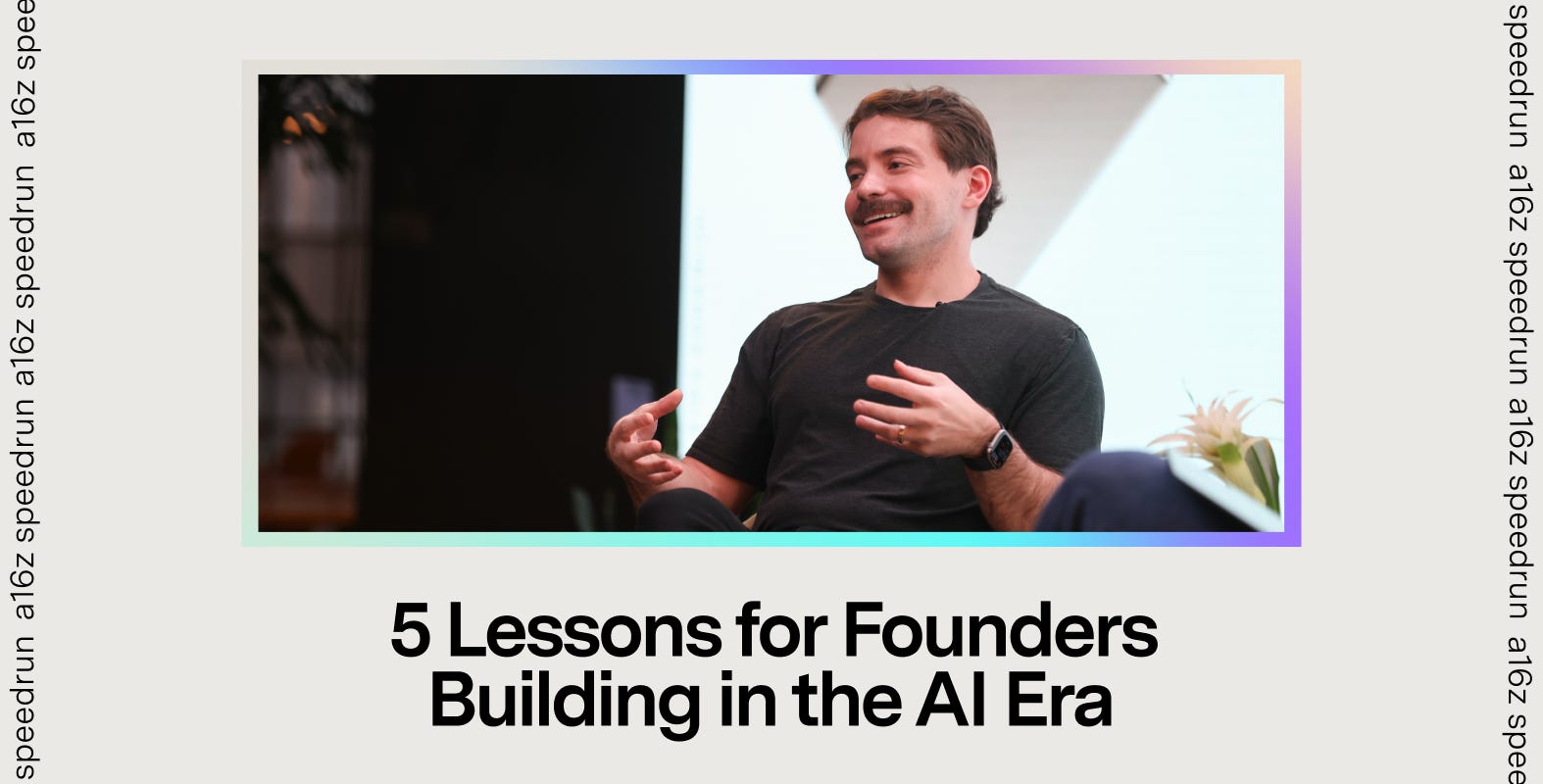
Guillermo Rauch is the founder and CEO of the web development platform Vercel and the creator of Next.js, one of the most widely used frameworks on the internet.
In a fireside chat with a16z Investment Partner Gabriel Vasquez, Rauch explained how open source can accelerate product-market fit and why ruthless focus matters more than ever in the age of AI.
Watch the full fireside below, or scroll down for our top five takeaways from the conversation.
Rauch’s framework for open source is to treat it as a filter. The two hardest problems for any startup are getting people to know you exist and building the right thing. Open source, in his view, stress-tests both at once.
“I’ve always thought of open source as a speedrun to product-market fit, because if people don’t use it when it’s free, when it’s easy to consume, when the code is available, then you probably should be working on something else.”
He acknowledged the obvious downside: openness makes replication easier, especially in the age of agents. But Rauch argued that the best open source projects extend into broader platforms, and success surfaces new problems to solve. Next.js itself is only a sliver of the cloud problem enterprises actually face.
“What stops entrepreneurs in their tracks is that they worry too much about what’s going to happen in the future. In reality, they don’t even have product-market fit yet.”
Asked about the most important focus decision in Vercel’s early days, Rauch described a tension he calls the “bicameral mind.” You need a bold, boundless long-term vision. But on any given Tuesday with three people in the room, that same ambition will destroy you if you let it dictate what you build.
“When you’re getting started and you’re three people, if all you do every day is unbounded ambition and building two hundred million different features, then you’ve fucked up.”
Early Vercel tried to make everything deployable: every language, every runtime, every framework, even databases. Then Rauch forced the question: where are we being truly excellent? The answer was the front-end layer, a new kind of managed service that didn’t exist yet. The result was the difference between building something no one would pay for and building something worth hundreds of millions.
“If I had continued doing everything, I would have made a company that made zero dollars. Literally zero dollars. Discerning buyers want the best of each class of problem. They don’t settle for the second-best solution.”
In an era where AI makes everything buildable, the temptation is to build everything. But that’s exactly backward. When every problem becomes shallow with enough tokens, choosing which problems deserve your attention becomes the real competitive edge.
“A bunch of you are probably already over-building massively because you notice that you can just prompt it and it’ll do it. But the discernment of what problems are worth solving could be one of your biggest differentiators.”
He illustrated the point with a contrast from inside Vercel. A good use of AI: having an agent work overnight on a JavaScript optimization that made the platform twenty to forty percent faster for customers. A bad use: rewriting your internal HR tools. The CEO’s job, Rauch argued, is increasingly about helping the company decide what’s worth investing in when everything is possible.
On talent, Rauch’s advice was to look for people on the rise rather than people who’ve already arrived. Find the ones shipping high-quality work, especially with AI tools, and pay attention to something most hiring managers ignore: how candidates communicate what they’ve built.
“Sometimes the reason I reach out to people is not just what they built, but how they communicate it.”
He told the story of sliding into a developer’s DMs after seeing their novel approach to a well-known UI problem, while also finding a new way to package and explain a contribution. Rauch extended this into a broader product philosophy, comparing it to Apple’s unboxing experience: the website, the store, the feeling of lifting the lid. Every layer of the experience has been thought through.
“I sometimes see slop landing pages from startups. It’s a recording of the entire desktop of the entrepreneur, and it’s just so busy. I see his dock with two hundred applications, his entire browsing history, two hundred plugins. Delete all the things that are not your thing, because they’re an excuse for people to get distracted.”
Rauch closed with a point about conviction. In a world where every new tool and framework generates immediate hype, the ability to say “no” is underrated. His approach is to never outsource judgment. He downloads products, signs up, uses them firsthand. If he can’t deeply understand something himself, he doesn’t build conviction around it.
“Silicon Valley has this sharp edge of people just get so f***ing excited about everything. And some of those things are worth dismissing. Choosing what you dismiss can also be a competitive advantage.”
The two-phase process he described: experiment broadly, then set a high bar for what you actually bring to market. When you do find something that clears that bar, go all in. Post it everywhere, email it, present it. But don’t confuse the excitement of experimentation with the conviction required to ship.
“If I don’t fully understand it myself, it’s very hard for me to actually build conviction.”
Thanks to Guillermo Rauch for sharing his insights with our founders. And for more weekly dives into the world of early stage startups, subscribe below.
