Saved: 2026-04-02-224753
Title: Liquid Death’s Mike Cessario on Building a Brand That Can’t Be Copied
Published Time: 2026-04-02T15:44:51+00:00
Markdown Content:
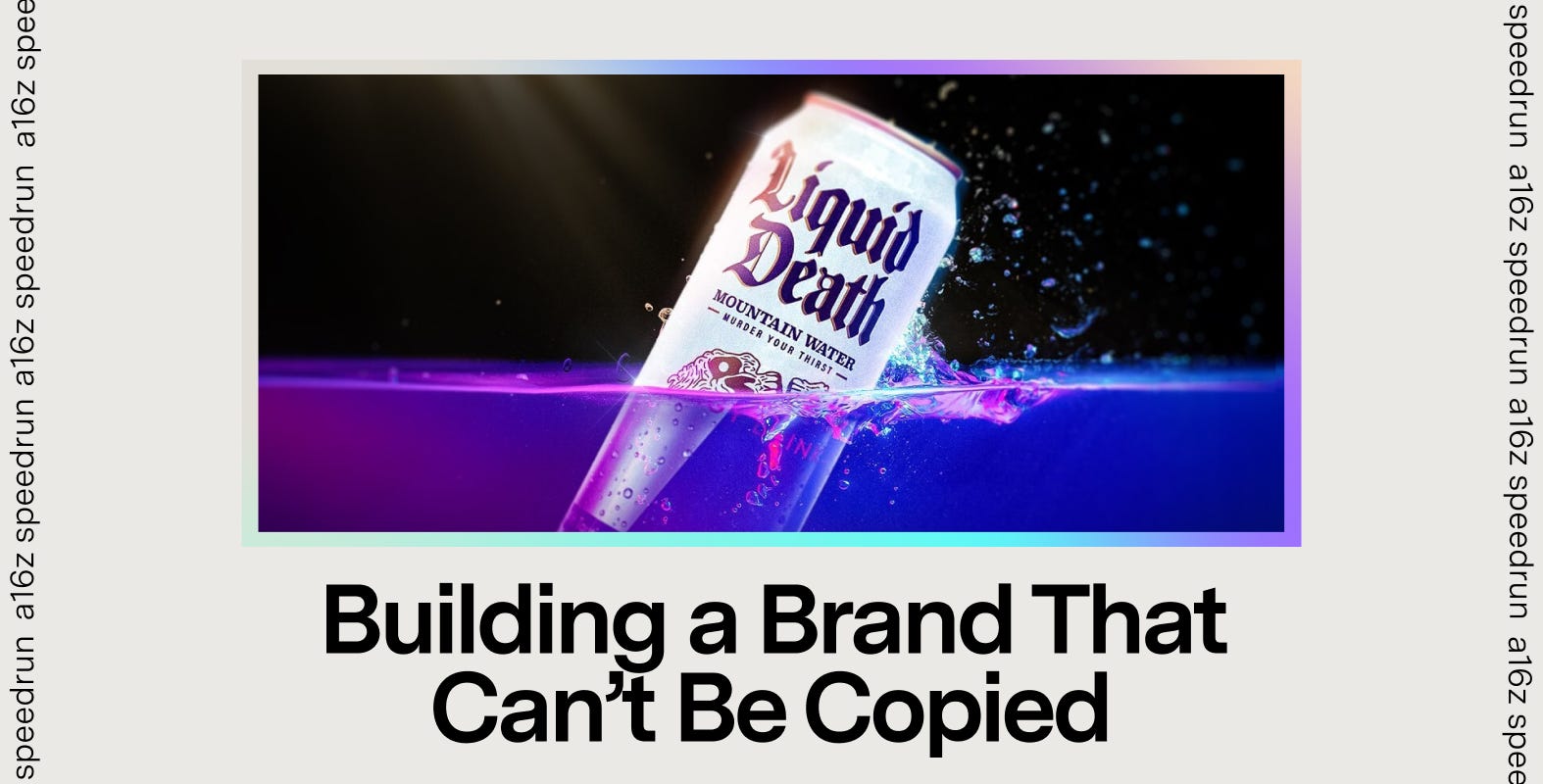
Liquid Death is a healthy beverage company that looks like a beer brand, markets like an entertainment company, and grows like a tech startup. Founded in 2019 by Mike Cessario, a former ad creative with a background in making funny videos on no budget, the company has expanded from water to sparkling water, iced tea, and now energy drinks, doing hundreds of millions in revenue along the way. The company ran a Super Bowl ad this year which they produced internally for $300,000.
In a conversation with a16z speedrun, Cessario laid out the thinking behind the brand: why he assumes every product is a commodity, why comedy is the last unoccupied competitive moat in consumer goods, and what it actually takes to get a can of water onto a shelf at Kroger. Most of his advice applies far beyond beverages.
Watch the full conversation below, or scroll down for our top five takeaways from the conversation:
Cessario’s career started in ad creative, and he’s always had a knack for making people laugh. He built Liquid Death’s competitive strategy around humor and entertainment in part because it’s structurally inaccessible to the biggest players in the market.
“Let’s say you want to do athlete marketing. Anybody with a checkbook can buy any athlete they want. If you’ve got the big enough number, you can get any snowboarder, any NFL athlete. So if you try to have a sports marketing theme for your brand, you’re just competing with every other giant brand that can just spend way more money than you can to, to, to buy more athletes or whatever. Comedy is the one thing that Coke and Pepsi can’t really do. Comedy is the one thing that Coke and Pepsi can’t really do. Even if they wanted to, true comedy can’t really survive in that bureaucracy.”
Cessario pointed to the experience of A-list comedians who’ve done deals with major brands, like Ben Stiller doing a Pepsi campaign. The story is always the same: everything funny got killed in the approval chain. “You actually had to work to make this person not funny,” he said.
Cessario’s framework for thinking about brand starts from a premise that most founders resist: your product is probably not that different from your competitors’. He argued that founders get so deep in the weeds that they overweight tiny product differences that the broader market doesn’t notice or care about.
“Does Nike ever talk about how its materials last twenty days longer than Adidas? Any mustard on the shelf is probably all the same f***ing mustard. Can anybody pick out their favorite beer in a blind taste test? Probably not.”
His advice: start from the assumption that product differences are slim to none, then figure out how you win. Either you win on price and become the cheapest option, or you win because your commodity is far more memorable than everyone else’s. This thought exercise, he argued, is what forces you to invest in the things that actually create differentiation: brand, entertainment, and emotional connection.
Cessario described Liquid Death’s model inspired by the Red Bull playbook, with one substitution: comedy instead of action sports. The ethos is entertain people first, sell beverages second. That’s not a tagline. It’s the operational reality of how the company allocates resources.
“I made a video for fifteen hundred bucks that got three million views and generated more page followers than Aquafina with almost no investment. That’s proving out the model: if you can entertain people in commoditized categories, you’re going to have this huge competitive advantage because no one has any real product advantage.”
The economics have held at scale. Liquid Death’s Super Bowl ad cost $300,000 to produce internally, much lower than industry averages.
“We’re trying to make people laugh on the internet. As long as you can do that, you’re going to attract people and they have a reason to tune in. We’re occupying a place in their mind when they have five seconds to choose what to buy walking down the aisle.”
Asked to define what brand actually means, Cessario drew a distinction most founders miss. A lot of products are cool. Very few companies are cool. The strongest brands are the ones where people think the company itself is cool, independent of any specific product.
“There’s a lot of really cool products out there. But there’s very few cool companies. If you ask people, ‘What’s a really cool company?’ That’s where you start getting down to the people who are really good at brand.”
He used ChatGPT as a current example. Every LLM does more or less the same thing. But one brand dominates because it occupies a place in people’s heads, the way Google did with search.
Cessario also pushed back on the idea that mission alone drives loyalty. He told the story of an Uber driver who fell in love with Liquid Death’s “death to plastic” message. But the real reason she’d keep buying, he argued, is that the can gives her permission to participate in a counterculture she wouldn’t otherwise access. The mission is how she justifies it. “If that were really the only reason, the minute there was canned Smartwater, she’d buy that because it was cheaper.”
For founders who’ve only operated in software, Cessario’s description of beverage distribution is a wake-up call. Getting authorized in a retail chain is relatively straightforward. One meeting with a Walmart buyer can open four thousand doors. The problem is what happens next.
“As a small brand, you’re authorized in two thousand Krogers, but you’re only on the shelf in seven hundred, because the distributors just aren’t actually getting the product to the retailer. They don’t care, and there’s nothing you can do about it.”
The beverage industry runs on DSD (direct store delivery) networks owned by Coke, Pepsi, and the beer companies. You can’t use Coke’s or Pepsi’s distribution unless they own you. The beer networks are different because of the three-tier system: alcohol laws prevent producers from owning more than twenty percent of their distribution. So hundreds of independent distributors exist, and a new brand has to win them over one by one.
But even then, it’s a challenge to get distributors to get you priority:
“As a new brand, you’ve got to go one by one to all these guys and convince them to distribute your product ,to take your product and sell it to Walmart and Target and Kroger and 7-Eleven and everywhere else. But they’re also selling Budweiser and Bud Light and Michelob Ultra and all these other brands. So when you go in as a small brand, you’re so far down the totem pole. The rep is going into a Kroger and he’s only going to be there an hour. He needs to go to the next store. Most of his time is going to be restocking Bud Light.”
This, says Cessario, is why managing distribution is far and away the hardest part of scaling a new ready-to-drink beverage company.
Thanks to Mike Cessario for sharing his insights with us. And for more weekly dives into the world of early stage startups, subscribe below.
